
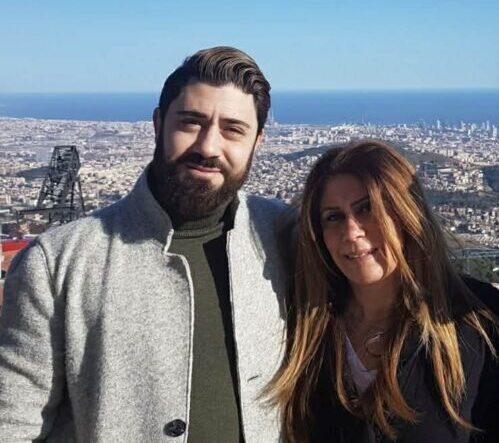
With this text, I would like to remember and honor my mother on the anniversary of her passing.
"Sleep well, my son," she said with a broad smile and closed the door behind her. I remember those words and the way she said them. I remember the bedroom, filled with her love and warmth. I remember the strong sense of security that enveloped me simply because she was there. They say there’s a special bond between a mother and her eldest son. And I’m inclined to agree. My mother embodied the definition of genuine, unconditional love, which I always felt until I reached adulthood. Just as she showed love to her children, she constantly expressed her love for her roots. To the land of her ancestors. To her homeland, Assyria.
Fehime Danho, daughter of Mirza and Zaro Demir dbe Khačo/Mirzake, was born in 1967 (listed as one year older in her passport) in the village of Anhel (Enhil), Turabdin. She emigrated with her family to Sweden in the 1970s, like many other Assyrians from Turkey, and settled in Eskilstuna in Sörmland. Here she attended elementary and high school, while young Fehime quickly became involved in the Assyrian movement, particularly in the Assyrian Association in Eskilstuna. In her new country, she married Fikri Danho dbe Kahya at a young age, and shortly thereafter I was born, eventually becoming the older brother to Daniel and Nathalie.
For those of us who grew up within the Assyrian movement, words like “Assyria,” “Bethnahrin,” “huyodo,” “indigenous people,” and “umtho” are second nature to us. These were terms we heard both at the association and at home. Among many other things, we were taught that our ancestors founded the world’s first civilizations. And the home is, of course, often seen as a child’s first school. That turned out to be true in my case as well. My mother, in fact, came to play a key role in shaping my identity as a young person.
For my mother, those thousand-year-old roots were an important part of her identity. It was important to her to explain to non-Assyrians which ancient ethnic group she belonged to. She passed this on to me as well. She made me aware of my ethnic and national identity at a young age and taught me about our culture, our traditions, and our history. While it was common for others in our ethnic group to identify based on their Christian faith, it was clear to me even as a child that I was not a Christian Arab, Kurd, or Turk. Nor was I a “Christian from Turkey.” No. I was an Assyrian. From the Turabdin region, in the land of Assyria. Which was once the cradle of civilization.
I remember that day so well. We were on our way to my school in Eskilstuna for a parent-teacher conference when, on the way there, my mom gave me an impromptu history lesson. It wasn’t the first—nor would it be the last—time I received such informal instruction. “The Assyrians were massacred, Michael. The perpetrators were Muslim Arabs, Turks, and Kurds, who together nearly wiped out the Assyrian people.” I looked at Mom with a serious expression and nodded as we walked toward the school. Mom often looked pleased when she spoke to me, as if she felt her message was getting through to me. Which it certainly did.
This is what an everyday conversation between us might have looked like. Between mother and son.
The conversations in the kitchen, in the living room, in the car. At the swimming pool and around town. They shaped me. My mother planted a seed in my heart when I was just a baby, which helped me develop a love for my people, for my homeland, Assyria. This isn’t about any kind of ethnocentrism, as if Assyrian ethnicity were superior to any other. No. It’s about feeling a genuine love for one’s roots, for one’s culture and traditions, without, for that matter, belittling other ethnic groups and cultures.
For how can anyone fail to feel sympathy for a people whose very existence has been under threat since the fall of the Assyrian Empire—a people who have been subjected to constant persecution, as well as mass killings and genocide?
These were stories filled with barbarism and brutality that I heard from both my mother and my grandmother throughout my childhood, just like many other Assyrian children. In addition to the genocide and mass killings, we remember the forced conversions and expulsions. We remember several hundred years of oppression. People speak of a collective trauma, passed down like an unbroken chain, from generation to generation.
Our ethnic group’s inseparable ethnic identity was something of a sacred matter to my mother.
Ha ’amo na! (we are one people!) my mother would exclaim firmly during an ongoing discussion with people who held different views on our ethnic/national identity. My mother was strongly influenced by this cornerstone of Assyrian national ideology: that we are ethnically Assyrians from Assyria, one and the same ethnic group, regardless of religious, geographical, and linguistic/dialectal differences. One people, one language, one nation.
A Chaldean Assyrian is no less Assyrian than a member of the Church of the East, and my mother herself, who belonged to the Syrian Orthodox Church, is neither more nor less Assyrian than anyone who belongs to another Christian denomination. One should not confuse ethnicity and nationality with faith, my mother reasoned. We must not forget that today there are also Assyrians who see themselves as secular, and who therefore do not wish to be associated with any church. My mother, however, expressed joy and pride in being a Syrian Orthodox believer, a member of one of the world’s oldest apostolic churches, while at the same time being a proud Assyrian, a daughter of Assyria, one of the world’s oldest nations.
Just as my mother cherished her Assyrian identity and emphasized the importance of preserving our Assyrian heritage and roots, she was also a strong advocate for integration. My mother’s Swedish was perfect (without the slightest accent); she sang along to Swedish classics while doing housework when I was little in the 1990s, and she socialized with Swedish friends. At the same time, it was also important to her not to let assimilation creep in and knock on the door. This balancing act defined my mother. She inspired me to be both Swedish and Assyrian. Through her values, actions, and words, she showed that it is entirely possible to help build Swedish society, celebrate Swedish holidays, and stand up for Swedish values—while maintaining a strong connection to her Assyrian roots.
In recent years, my mother felt a strong longing for home and dreamed of returning to visit her hometown of Anhel for the first time since she left her homeland; she had concrete plans to make that dream a reality. Unfortunately, my mother never got the chance to make it happen, as she passed away suddenly after a brief illness on April 17, 2024, in Stockholm, at only 56 years old. Far too soon. Far too young. St. George’s Syrian Orthodox Church in Norsborg was filled with mourners at the funeral service held on April 23, as we said a painful goodbye to a woman who meant so much to so many people.
In the midst of the unimaginable—that my mother is no longer with us today, that I can no longer have those conversations with her, that I can no longer hold her or laugh with her—in the midst of this bottomless grief and unbearable pain, I feel a sense of gratitude for being her son, for being able to call her my mother.
Thank you for giving me an identity, so that today I feel grounded and secure in it. Thank you for teaching me as a child what the Assyrian struggle is all about. Thank you for teaching me about my roots, and for telling me who I am.
But above all—thank you for the mother you’ve actually been. I’m convinced that you’re smiling and happy that I’ve chosen to write and publish this piece in the magazine you grew up with and held in such high regard.
Now it’s my turn to say, “Sleep well, dear Mom. Until we meet again.”

