
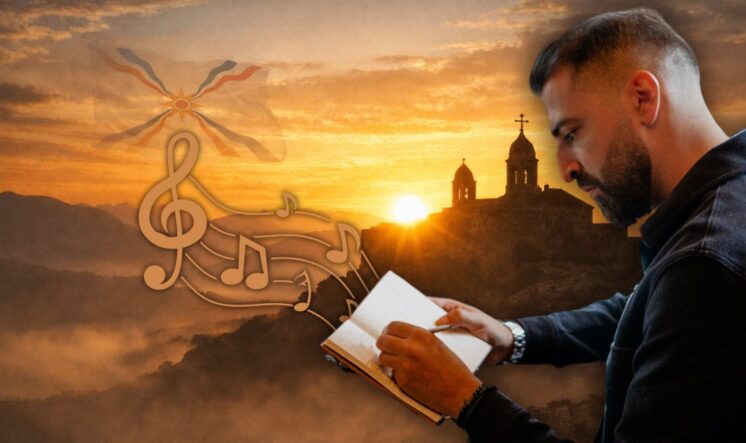
Assyrian music with a touch of gold. That’s how Asuryoye Soundworks describes itself, with the aim of creating new songs about the flag, the people, and the homeland. With pen in hand stands the author Nemrud Kurt-Haninke. “I want to change the narrative. We are not victims. We are survivors. The music should tell that story,” he tells Huyodo.
New technology has opened new doors, particularly for Nemrud Kurt-Haninke. He is the author of three books, most recently with a German translation of *The Dead Teach the Living*. Now he is shifting his focus to music.
Together with producer Asuryoye Soundworks, he is creating new Assyrian music—a blend of traditional tones and modern influences. Kurt-Haninke writes his lyrics in Western Assyrian (Suryoyo), putting his emotions into words to awaken his nation.
– I’ve been writing my whole life, but at my core, my passion lies in creating. And creation can take many forms. You can build with words and write books, or you can use the tools of our time to create film or music.
The Mountain Calls
His debut song is titled “I Am Tur Abdin,” released on the Assyrian New Year. It is a song told from the perspective of the sacred mountain, a call to its lost children. Kurt-Haninke weaves together personal fragments—“in my aunt Seide’s hand there is abundance”—with messages directed at all Assyrians. An excerpt:
”Mi golutho qeymin qeymin,
Nisha, Ninorta, u i Nahrin,
Mor Gabriel alle qrele
B-Mor Malke Shahro Msharele
(…) Juddokh u Qashtokh, b-zabne u dore
"Lo lo toratli dlo more"
(From exile they will rise—Nisha, Ninorta, and Nahrin. Mor Gabriel calls for them; in Mor Malke, the celebration has begun (…) Your grandfather and grandmother through time and generations, do not leave me alone).
Named after his daughter
Kurt-Haninke makes no secret of the fact that artificial intelligence cannot yet replace the human touch. But it is good enough - for now - and that is how the idea for the album "Echoes of Edessa" was born.
– Done is better than perfect. This is better than nothing. At the same time, I hope to have our established singers perform these songs soon. Listen to “I Am Tur Abdin” and imagine Kamil Hanna’s majestic voice. No technology in the world can surpass that, says Kurt-Haninke, and continues:
– The name of the album was obvious. My daughter is named Edessa, because the city stood as a cultural heir to the Assyrian world after the fall of the empire. You could also argue that it was the first Christian kingdom in history under King Abgar Ukomo. This album is an echo from that time, from that city.
“We’re doing our enemies a favour”
For Kurt-Haninke, the message is clear: the sons and daughters of Assyria need to waken up.
“We have two fundamental problems. First, we speak about ourselves as victims. That’s understandable given everything we’ve endured, but despite that, we’re still here. That makes us survivors. I want to change the narrative. The music can tell the story that we have survived for 6,776 years,” he says, and continues:
– Second, we have started to accept calling ourselves Suryoye in Swedish. We think it makes us neutral, that it unites us. The truth is, we are undermining our own name, killing our chance to claim anything. Yes, we are Suryoye, but if we remove “Assyrians,” we are doing our enemies a favour. They have never managed to erase our ethnic identity. Are we going to do it for them now?
Listen to I Am Tur Abdin here.

