
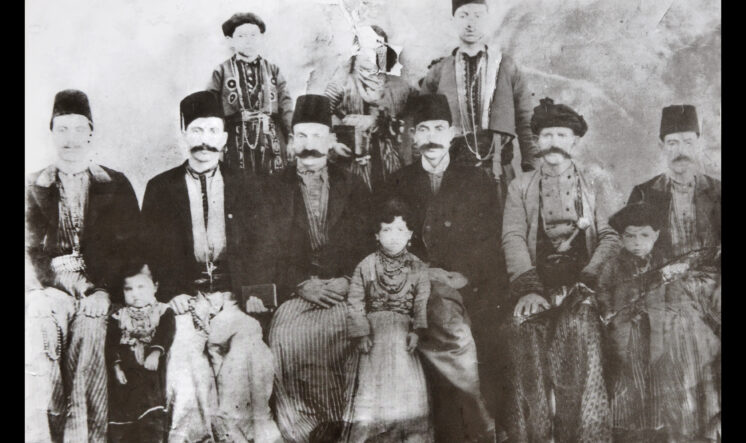
The Hirmiz family, photographed around 1903–1904. Top row, from left: Hannah Hirmiz, Unknown, Suleman Gelle Hirmiz. Middle row, from left: Davod Hirmiz, Hirmiz Gelle Hirmiz, Shabo Hirmiz, Gelle Hirmiz, Shamoun Rhawi, Isa Hirmiz. Bottom row, from left: Romia Hirmiz, Nabiha Hirmiz, Circis Hirmiz
This text is a response to the book *Sayfo Rabo – The Massacres of Midyat and the Calamities of Tur Abdin* written by Safar Safar.
Like many others, I grew up listening to stories. From my grandfather Circis Hirmiz, my father Semir Hirmiz, Hannah Hirmiz, Selve Hirmiz, Sabri Hirmiz, and Ferit Hirmiz. But also from people with no connection to our family at all, who time and again have attested to the Hirmiz family’s significance and contributions in Midyat.
What I am saying is based not only on family tradition and stories passed down around the dinner table, but on a broad, independent body of evidence. This text is not intended to attack anyone personally—it is about responsibility, truth, and respect for how history is portrayed.
I will not go through every inaccuracy in *Sayfo Rabo*. Nor will I cite all the independent, documented sources that have been published over time. There is no need to do so. Even upon a first reading, it becomes clear that the author does not practice source criticism. What is presented is not a fact-checked history—it is a selective narrative, marked by envy, contempt for Protestants, and a consistently negative portrayal of the Hirmiz family.
A narrative driven by something entirely different from historical responsibility — by the need to whitewash one’s own image by smearing others. Distorting history through lies, envy, and hatred in order to make oneself look better—that is unacceptable. And it must be called by its proper name.
The book’s smear campaign against the Protestants is clear. It is a one-sided, distorted portrayal, solely because they were Protestants. The Hirmiz family is consistently portrayed in a negative light—not with factual evidence, but through biased narratives, exaggerations, and outright fabrications. Quotes such as “Goodness, it would have been better if they had converted to Islam”and claims that they were money-hungry and greedy clearly illustrate this. That the Hirmiz family looked down on Orthodox Christians and did not marry their daughters off to Orthodox men is a claim that does not even deserve a denial—rather, it reveals the hostile bias that characterizes the entire account.
The most revealing section, however, concerns the account of the period following the Protestants’ sentencing to death. It includes statements such as:
“Let them go and never come back. I’d rather die than live as a Syriac who sold my lineage, family, and religion for a few dirhams collected at the end of every month.”
“They thought money alone ruled the world.”
“They entertained themselves by counting their gold coins and jingling them around.”
And yet this is followed by claims that they should be saved—for the sake of conscience.
After everything that has just been claimed.
This is where the book’s method becomes clear; through selectively chosen phrasing, a narrative is created in which hatred and contempt go unchallenged while reality is twisted to the author’s advantage. This account is not merely subjective. It is completely dishonest. It is a desperate attempt to elevate one’s own position by casting suspicion on others.
The truth isn't determined by who writes last.
It's determined by what can be substantiated.
And that's where it falls short.
As I mention in the introduction, there are many documented, independent sources that clearly demonstrate the role and significance of the Protestants and the Hirmiz family both before and during the Seyfo. These are ignored, downplayed, and completely distorted in the book; I therefore see no reason to bring them up here either. The book’s author has no interest in conveying the truth—the aim is to present a personal perspective, not historical justice.
And that intention is not only dishonest. It is disrespectful to all those who lived and died during the Seyfo.
Furthermore, to present reconstructed dialogues and quotes in the book—from both the Hirmiz family and other Protestant representatives—as if they were authentic, when they are clearly biased, is completely unacceptable and irresponsible. It is misleading.
Fiction must not be presented as history.
What gives you the right to put words in people’s mouths? To shape them to fit your narrative, in order to strengthen your own position while simultaneously casting others in a negative light?
After their death sentence, Gelle Hirmiz and several of my ancestors are led from prison to their slaughter. They march while singing hymns. They are brutally deprived of their lives. Their heroism is not a story fabricated after the fact. It has been documented and witnessed.
I would like to conclude with a publication from 1916, following the murder of Gelle Hirmiz. These are not fabricated quotes, nor are they biased accounts. It is a documented contemporary text, published in the newspaper Beth Nahrin by Naum Faik, one of history’s most respected writers and journalists. The publication is based on information provided by the correspondent Iskender in Turabdin.
Gelle Hirmiz is described as one of the city’s foremost intellectuals and leading figures—a “shining star” among the Christians of Midyat. His home was a place where the hungry were fed, and where both ordinary people and high-ranking officials gathered.
Furthermore, his deep commitment to his people is highlighted: his struggle to protect the residents, his work on behalf of widows and orphans, and his resistance to oppression and the abuse of power.
This is a contemporary voice.
A documented image. An image that stands in direct contrast to the version the book is now trying to paint—tainted by hatred, envy, and personal agendas.
The truth existed then. It still exists now.
This book is not a contribution to history.
It is an attempt to distort history through smear campaigns and lies. And as a daughter of the Hirmiz family, I refuse to remain silent.
And that is precisely why it must be addressed. Not with the same tone. Not with the same methods. But with something stronger:
Truth. Sources. Responsibility.
History is a matter of record—it is not for you to redefine.

