
Speech by Sabro Bengaro at the Seyfo Symposium, April 26, Hallunda.
I stand before you today to speak on a difficult but necessary subject: Germany’s complicity in the atrocities committed during World War I.
The mass violence directed against Assyrians, Armenians, and Greeks is still denied or downplayed by those responsible. This denial is not merely a historical issue—it is an ongoing injustice.
When the truth is suppressed, the wounds do not heal. They deepen. They are passed down from one generation to the next. And that is why we must ask ourselves: how can any nation truly move forward if it refuses to confront its past with honesty and accountability?
During World War I, the Assyrians—along with Armenians and Ottoman Greeks—were subjected to the Ottoman Empire’s policy of genocide. As one of the oldest Christian communities in the region, the Assyrians had a distinct ethno-religious identity and deep historical roots in what is now southeastern Turkey, northern Iraq, and northwestern Iran.
This tragedy unfolded across these border regions and resulted in the deaths of hundreds of thousands of Assyrians.
Many others were forced into exile, scattering Assyrian communities across the globe and creating a lasting diaspora. Although this occurred in the same context as the Armenian and Greek genocides, the Assyrian experience has received significantly less academic and public attention and is often described as one of the “forgotten genocides” of the twentieth century.
At that time, the Ottoman Empire was ruled by the Committee of Union and Progress (CUP), a nationalist movement that sought to transform the empire. Its leaders aimed to create a more unified and homogeneous state. In this vision, Christian minorities—including Assyrians—began to be increasingly viewed as a threat.
A decisive turning point came in November 1914, when the Ottoman leadership declared jihad, or holy war, against the Entente powers—Britain, France, and Russia. Although this was presented as a religious duty, it also had strong political undertones. This proclamation branded Christians as “infidels,” thereby further increasing suspicion, hostility, and violence against them. For the Assyrians, this meant they became direct targets of state-sponsored persecution.
To fully understand how and why this proclamation took place, we must also look beyond the Ottoman Empire—particularly to Germany, its ally during the war.
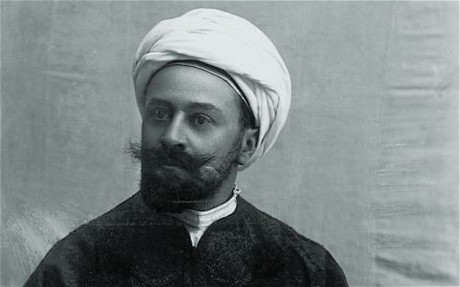
To understand the process behind the declaration of jihad in the Ottoman Empire, we must examine who Max von Oppenheim was and what role he played during this period. Max von Oppenheim (1860–1946) was a German diplomat, orientalist, archaeologist, and strategist.
He was the son of Albert von Oppenheim, a banker from Cologne who came from a prominent family of Jewish origin. His father converted to Catholicism before his marriage to Paula Engels, who came from a Catholic family. Although Oppenheim’s early applications to the Foreign Ministry were rejected due to his background, he was finally accepted in 1895, as Germany needed expertise on Egypt and the Islamic world. He served as a diplomat in Cairo from 1896 to 1909, during a crucial phase of German foreign policy toward the East.
Because of his close involvement with Muslim communities and his habit of wearing traditional local clothing in Cairo and Istanbul, Oppenheim became known as “Abu Jihad”.[1]
The historian Wolfgang G. Schwanitz also refers to him as the German “Abu Jihad” and notes that he drafted a 136-page master plan in October 1914.
Oppenheim, however, was not the only German associated with Islam. Kaiser Wilhelm II, the German emperor, visited Damascus in 1898, where he proclaimed himself the protector of 300 million Muslims. German intelligence later spread rumors that he was considering converting to Islam. As a result, many Muslims in the Middle East began to believe this and called him “Hajji Wilhelm.”[2]
When World War I broke out, Oppenheim’s deep knowledge of the Islamic world made him invaluable to German policymakers.
In 1914, Oppenheim developed a plan proposing that Germany could weaken its enemies by encouraging Muslim populations living under British, French, and Russian rule to revolt. His proposal became known as “The Grand Memorandum.”
As part of this strategy, Germany supported propaganda efforts aimed at spreading pro-jihad messages. This led to the creation of an organization in Berlin called the Nachrichtenstelle für den Osten (Intelligence Bureau for the East), a propaganda and intelligence unit based in Berlin.
This office produced newspapers, pamphlets, and other materials in several languages with the aim of mobilizing Muslims in various regions. As a central part of the propaganda campaign following the proclamation of jihad in 1914, the Eastern Intelligence Unit served as a hub for pan-Islamic communication. During the war, it engaged captured soldiers in propaganda efforts and established units to mobilize prisoners of war against their former armies. These units were staffed by multilingual writers and speakers and published newspapers—most notably El-Jihad—in Turkish, Persian, Arabic, Hindi, and Russian. The articles were first written in German and then translated for wider distribution.
The Ottoman Turkish leadership had a somewhat different strategy or expectation regarding the declaration of jihad. They envisioned political unity among all Turkish-speaking peoples under the ideology of Turanism, also known as Pan-Turanism. Jihad was used as a political tool to mobilize Muslims and support nationalist goals.
The jihad proclaimed on November 14, 1914, by the Sheikh ul-Islam—the highest theological authority in the Ottoman Empire—consisted of a five-part fatwa calling on Muslims to fight against the Entente powers: Great Britain, France, and Russia. Thousands of pamphlets, written and printed in Berlin by the Eastern Intelligence Unit, were transported to Constantinople (now Istanbul) and distributed among the population. These pamphlets urged Muslims to rise up and fulfill their religious duty. Shortly thereafter, similar material was distributed throughout Anatolia and other Ottoman territories.
Shortly after the declaration of jihad in Istanbul, during the so-called Jihad-i Ekber ceremony, the Tokatlıyan Hotel—owned by an Armenian—was attacked and looted by groups carrying green flags symbolizing Islam. This attack foreshadowed the violence that would soon engulf Christian communities throughout Anatolia, Tur Abdin, and the Urmia region. The Tokatlıyan Hotel was not the only establishment affected during this period. After the Ottoman Empire entered World War I, a jihad was proclaimed and read aloud in mosques throughout Anatolia. This contributed to increased tensions and outbreaks of violence against Christian communities, in conjunction with broader war dynamics, state policies, and local conflicts.
The Assyrians’ oral testimonies and accounts describe how religious rhetoric was used to mobilize segments of the population.
At the same time, Max von Oppenheim promoted and led what became known as the German “jihad strategy” in Germany. He believed that by encouraging the Ottoman Caliph’s call to jihad, one could persuade Muslim populations under British, French, and Russian rule to revolt, thereby weakening the Entente powers during World War I.
In British India, for example—home to one of the world’s largest Muslim populations—no widespread uprising took place. On the contrary, over a million Indian soldiers fought for Britain during the war, including many Muslims. Similarly, the British hold on Egypt remained stable despite expectations of an uprising, and local political issues carried more weight than religious calls for jihad.
It is clear that the German strategy was not successful.
The Muslim population did not revolt against Britain. Consequently, many Western and Turkish historians—such as Christiaan Snouck-Hurgronje, Erik Jan Zürcher, Tilman Lüdke, Mustafa Aksakal, and Kerem Çalışkan—whose analyses are based on Germany’s strategic objectives, have described the declaration of jihad as a failure or a failed attempt. At the same time, these perspectives do not offer a comprehensive understanding.
The Ottoman leaders did not simply “blindly” obey Germany’s will and declare jihad on November 14, 1914.
The leadership of the Committee of Union and Progress (CUP) declared jihad with the aim of uniting all Turkish-speaking peoples into a single entity. This was the great dream of the Ottoman leaders. Their strategy in declaring jihad was to take a step further toward their Turan, also known as Pan-Turanism. This was a movement to politically and culturally unite all Turks in Turkey and in other countries. Jihad was a tool in their hands to mobilize the Muslim population and achieve their goal. It is clear that their grand dream was not fully realized; however, the Muslim population participated in the killing of Armenian and Assyrian Christians in Anatolia.
The jihad declaration helped mobilize large segments of the Muslim population, whether they were Turks or Kurds. Religious language and symbolism were used to justify violence and encourage participation in campaigns against Christian minorities. Such large-scale killings would not have been possible without the participation of ordinary individuals.
Beginning in 1914, Ottoman forces—often in collaboration with Kurdish tribal militias and local groups—launched coordinated attacks against Assyrian villages.
Significant massacres took place in regions inhabited by Assyrians, in Hakkari, Van, Diyarbakir, and Tur Abdin, including Urmia and its surrounding villages, which are now located in present-day Iran. In October 1914, the Russian vice-consul in Urmia, Vedensky, inspected destroyed Assyrian villages and reported:
“The consequences of the jihad are everywhere. In the Assyrian village of Angar, I saw charred bodies with large, sharp stakes driven into their stomachs. The houses have been completely destroyed by fire, and flames are still burning in nearby villages.”
Furthermore, in his 1918 book, *The Rage of Islam*, Younan H. Shahbaz describes the suffering of Christians under Turkish rule and claims that German and Turkish agents intensified jihadist propaganda in places such as Urmia, with the aim of inciting Iranian Muslims and triggering a “Great Holy War.” “Muslims everywhere are fighting on Germany’s side; French, English, Serbian, Russian, and Japanese forces are being defeated. The Turks, under the Padishah of Istanbul, have defeated the Russians in many clashes. The English have not yet been completely defeated; every Muslim, aware that he must die, also knows that he dies for Allah. Allah has seen the banner of the holy war with his own eyes.”[3]
Assyrian regions such as Hakkari, Tur Abdin, and Urmia witnessed devastating massacres. Villages were destroyed, men were executed, and women and children were subjected to forced conversions, sexual violence, and death marches under extreme conditions.
Historians estimate that between 250,000 and 300,000 Assyrians were killed—roughly half of their population within the Ottoman Empire.[4] Survivors fled to various parts of the world, including Russia and South America, where they formed diaspora communities and preserved their history through memory and tradition.
In this context, jihad became more than just a religious declaration—it became a political tool. It was used both to support military strategy and to advance internal political measures aimed at reshaping the empire’s population.
Henry Morgenthau, the U.S. ambassador to the Ottoman Empire from 1913 to 1916, provided one of the most detailed contemporary accounts of the persecution of Armenians, Assyrians, and Greeks in 1915. Morgenthau, who was well acquainted with the leaders of the Committee of Union and Progress and maintained strong ties with them, noted that their political pursuit of Pan-Turkism necessitated the extermination of the Greeks, Assyrians, and Armenians, all of whom were Christians. He described how religion was used to mobilize the population and “Turkify” the nation. According to Morgenthau, Talat Pasha later boasted: “I have accomplished more to solve the Armenian problem in three months than Abdul Hamid accomplished in thirty years.”[5]
Historians estimate that between 250,000 and 300,000 Assyrians were killed—roughly half of their population within the Ottoman Empire. Survivors fled to various parts of the world, including Russia and South America, where they formed diaspora communities and preserved their history through memory and tradition.
In this context, jihad became more than just a religious declaration—it became a political tool. It was used both to support military strategy and to advance internal political measures aimed at reshaping the empire’s population.
According to Morgenthau, the goal was clearly to promote the Turkification of the nation by using religion as a tool and ensuring the participation of a large segment of the population. Their goal of Turkifying the nation seemed to necessitate the extermination of all Christians—Greeks, Assyrians, and Armenians.[6]
In conclusion, I would like to emphasize that the attempt to use religion as a global weapon during World War I was bold but ultimately failed on the international stage. Within the Ottoman Empire, however, the declaration of jihad contributed to an environment in which mass violence against Christian populations—particularly the Assyrians—could be justified and carried out.
During World War I, the Ottoman Empire had a population of approximately 14.5 million people, of whom about 4.5 million—roughly one-third—were Christians. Today, however, Christians make up only about 0.1 percent of Turkey’s population.
The story of the Assyrian genocide reminds us not only of the human cost of these political actions, but also of how ideology, politics, and war can become intertwined in profoundly destructive ways. The founding of the Republic of Turkey is based on the extermination of the Christian population. Yet Turkey denies the genocide it committed. This is the greatest obstacle to the healing process. To deny a genocide is to be killed twice.
We harbor no hatred. We harbor no hostility. We harbor no animosity in our hearts. We could never, ever dream of an agenda that divides people. All we want is justice. Pure. Uncompromising. Inevitable.
Those living today—Turks, Kurds, and others—are not personally responsible for the genocide. No, they are not. But there is a collective responsibility. A responsibility that weighs heavily. The genocide was committed in the name of their nation and religion.
That is why every Turkish individual has a duty. Every Kurdish individual has a duty. A duty to stand up for the truth. A duty to acknowledge the Assyrian, Armenian, and Greek genocides. A duty to heal the wounds that still burn. A duty to carry the light of justice forward.
Justice, truth, and healing—that is our goal.
Thank you!
Sabro Bengaro
[1] Çaliskan, *The German Jihad and the Armenian Deportation*, p. 79.
[2] Sean McMeekin, *The Berlin-Baghdad Express: The Ottoman Empire and Germany’s Bid for World Power*, Reprint edition (Belknap Press, 2012), 16.
[3] The Rage of Islam; an Account of the Massacre of Christians by the Turks in Persia, p. 52.
[4] Naayem, *Shall This Nation Die? * XXX.
[5] Morgenthau, *Ambassador Morgenthau’s Story*, p. 288.
[6] Morgenthau, *Ambassador Morgenthau’s Story*, p. 244.

