Naum Faiq (Naum Elias Yaqub Palakh) was born in one of the traditional stone houses within the walls of Diyarbakır. He was not only a poet and journalist, but also a linguist, educator, and cultural organizer. Born in 1868 in Diyâr-ı Bekr, Faiq grew up in a multilingual urban environment where he mastered Syriac (Assyrian), Ottoman Turkish, and Arabic. This linguistic diversity shaped his intellectual world and laid the foundation for the idea of cultural unity that would later characterize his work.
His early education in Diyarbakır gave him a deep understanding of both the structures of the Syrian Orthodox community and the pluralistic social order of the Ottoman Empire. Consequently, his ideas did not emerge from abstract ideological theories, but from the concrete experiences of urban life around him.
During his years as a teacher, Faiq became closely involved with educational issues within the Syrian-Assyrian communities in Diyarbakır and the surrounding area. His work focused not only on pedagogy, but also on fostering cultural awareness. For Faiq, the preservation of the language was an existential issue. He compiled dictionaries, collected expressions, and produced teaching materials to ensure that Assyrian would not be marginalized in the modernized world.
These efforts became a source of intellectual confidence for the Syrian-Assyrian youth in the region. From an urban historical perspective, his work not only contributed to written culture but also helped preserve Diyarbakır’s multicultural heritage.
After 1908, Faiq became increasingly prominent in the press. With the newspaper *Kawkab Madnho*, which he began publishing in 1910, he became an important voice for a cultural revival centered in Diyarbakır. The newspaper advocated unity beyond confessional divides and aimed to unite Syrian, Assyrian, and Chaldean groups around a shared historical identity.
Its influence extended beyond its readership. The publication also created a space for discussions about identity, language, and education within the city’s intellectual circles. In this way, Diyarbakır became not only Faiq’s birthplace, but also a center for his intellectual world.
Poetry and the City
Faiq’s poetry holds special significance in relation to Diyarbakır. His well-known exhortation , “Awake, son of Assyria, awake!” expresses the idea of a collective awakening, yet at the same time conveys the pain of separation from his homeland.
In his writings, Diyarbakır emerges not merely as a geographical location, but as a fundamental source of memory and identity. His work thus forms a symbolic layer superimposed upon the city’s physical structure. If the city’s memory lives on in both its stones and its texts, Faiq’s writings can be seen as part of Diyarbakır’s invisible archive.
The City's Memory and the Significance of the Place
A city’s memory is not merely the sum of historical events. It is the shared memory that lives on in the stones, streets, courtyards, door knockers, and nameplates. The connection between a city’s physical environment and its collective memory is reciprocal: places shape people, and people give meaning to places.
When a house falls into disrepair or disappears, it is not merely a matter of losing a building. It also means that a story, a sense of cultural continuity, and a social connection are damaged.
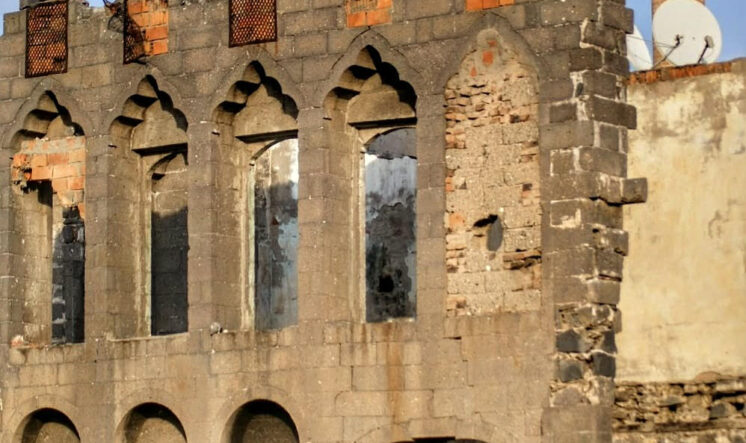
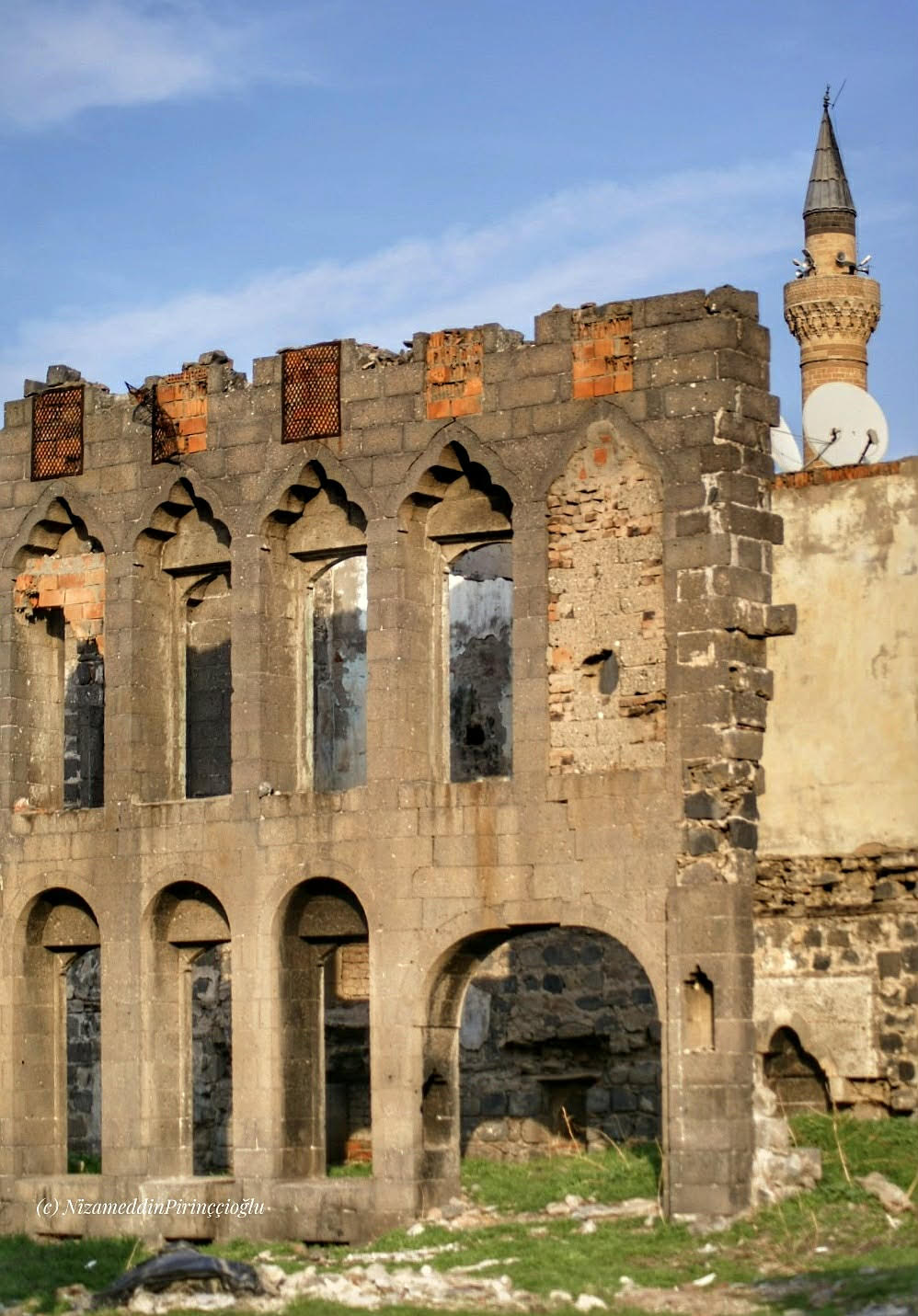
Naum Faiq’s house in the Sur district of Diyarbakır, which today lies largely in ruins, is at the center of this discussion. The house is more than just the place where a writer spent his childhood. It is a tangible memorial that embodies the city’s multicultural history and connects to one of the intellectual movements behind the Syrian-Assyrian awakening.
But without long-term protection and public accountability, this memory remains vulnerable.
This article aims to examine how a city’s collective memory is shaped, damaged, and can be made sustainable, using the example of a single building. At the same time, Diyarbakır’s situation is placed in the context of other cities where the lives and legacies of prominent figures have been integrated into the urban landscape.
The Testimony of the Site
The old city of Diyarbakır is a multi-layered urban environment where Armenians, Assyrians, Kurds, Turks, and Arabs have lived side by side for centuries. The black basalt courtyard houses, the narrow alleys, the churches, the mosques, and the caravanserais are not merely architectural features—they are tangible traces of a shared life.
Naum Faiq’s house is part of this tapestry. It was here that he grew up in a multilingual and multicultural environment that laid the foundation for his intellectual development. From the perspective of the city’s collective memory, the house represents a meeting point between an individual life story and a collective historical legacy.
Cities don’t just remember their intellectuals and artists—they also make them visible through their public spaces. Street names, museum buildings, monuments, and cultural centers are all ways of bringing their memory into the public sphere.
The fact that a street in Diyarbakır once bore the name “Naum Faik Palak” is a symbolic expression of this memory. But a street sign is not enough. For the city’s memory to endure, physical preservation, public narratives, and integration into education and culture are required.
From Name to Museum Building
One of the most effective ways to ensure the city’s memory endures is to preserve the places where significant figures lived and give them a public purpose.
Victor Hugo – Paris
In Paris, Victor Hugo’s former residence is now a museum open to the public. The house not only preserves the memory of a writer but also highlights the literary foundations of French national identity. Thanks to cultural heritage policies and public responsibility, its preservation has been made sustainable over the long term.
Franz Kafka – Prague
In Prague, Franz Kafka’s birthplace serves as a cultural and tourist hub. Kafka’s themes of alienation and identity are interpreted in relation to the city’s historical experiences, creating a link between literature and urban history.
Ahmet Hamdi Tanpınar – Istanbul
In Istanbul, the memory of Ahmet Hamdi Tanpınar is kept alive through museums and cultural institutions. His reflections on the city and the times are directly linked to the city’s historical identity and demonstrate how intellectual heritage can be integrated into cultural policy and urban development.
Ziya Gökalp – Diyarbakır
In Diyarbakır, Ziya Gökalp’s birthplace has been restored and turned into a museum. This illustrates how different historical figures can be treated differently in urban memory. While one house is restored and given a new lease on life, another is left to fall into disrepair. The city’s memory is often selective.
Selective memory and silent decay
Collective memory is not always inclusive. Which individuals are honored and which buildings are preserved is often determined by political, economic, and social power dynamics. This is particularly evident in cities with a multicultural history.
The fact that Naum Faiq’s house has fallen into disrepair cannot be explained solely by issues of ownership. It is also linked to the decline of the Syrian-Assyrian population in the region and the widespread diaspora. As the community members who preserve the memory weaken, the memory itself becomes more vulnerable.
A sustainable urban memory, however, requires a pluralistic perspective. If Diyarbakır’s Armenian, Assyrian, Kurdish, Turkish, and Arab memories are not considered together, the city’s history risks being reduced to a one-sided narrative. As a result, part of its historical richness is lost.
Proposals for sustainable conservation
Taking Naum Faiq’s house as a starting point, the following measures can contribute to a more sustainable urban memory:
- Public acquisition and restoration – overcoming legal obstacles and restoring the building while respecting its original character.
- Museum House Model – transforming the house into a research and cultural center dedicated to Syrian-Assyrian culture.
- City libraries for education and knowledge – one or more libraries that meet the needs of a growing population.
- Research and Archives Center – supplementing the physical location with digital documentation and archiving.
- Art center and gallery – developing joint projects in collaboration with the Syrian-Assyrian diaspora.
These measures are intended not only to save a building, but also to preserve cultural continuity.
The House, the Diaspora, and the Idea of Return
Naum Faiq’s life spans from Diyarbakır to the United States and reflects a broader diaspora narrative. The ruins of the house can be seen as a spatial metaphor for this separation. The gaps between the stones correspond to the cultural voids left behind by migration.
But memory never completely fades away. It can be rebuilt. A city’s collective memory is not just about preserving the past, but about passing it on to the future. When a building is restored, it is not just the walls that are brought back to life—the stories are revived as well.
From a single house to an entire city
Naum Faiq’s house in Diyarbakır is a powerful example of both the vulnerability and the potential of the city’s collective memory. The building bears the marks of a people’s cultural awakening. Preserving it means not only protecting the Syriac-Assyrian heritage, but also safeguarding Diyarbakır’s multifaceted history.
When a city’s memory is made sustainable, the city can not only remember its past—it can also come to terms with it and pass it on to future generations. Otherwise, all that remains is a silent memory wandering among the ruins.
The stones of Diyarbakır still speak: The question is whether we choose to listen.
About the author:
Nesrin Aykaç was born in İzmir, where she still lives. She is a journalist, author, and poet. In her home region of Mardin, she has worked as a freelance writer and columnist. Her writings have been published in the newspapers Mardin Söz, Mardin Life, and Mardin Haber, as well as in several national magazines.
Aykaç has published two collections of poetry and a book of memoirs and essays. Her work continues to be published on various platforms and in literary journals, both in Turkey and internationally. She writes in both Turkish and English.