
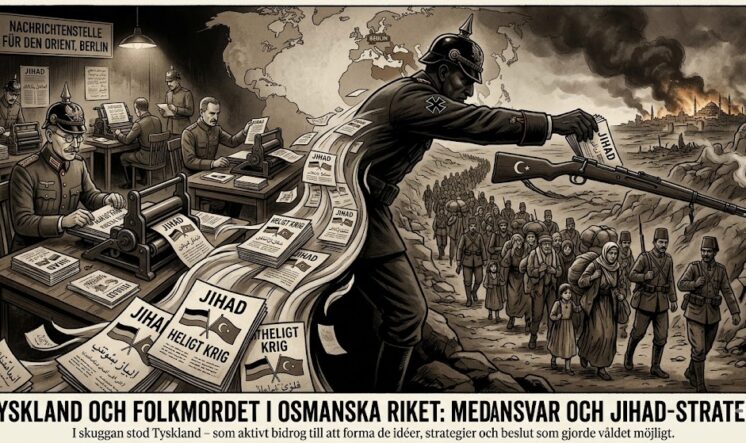
AI-generated image based on the article's theme
The genocide in the Ottoman Empire was not merely a Turkish crime. Germany stood in the shadows—actively contributing to the ideas and decisions that made the violence possible.
The genocide of Assyrians, Armenians, and Pontic Greeks during World War I is often described as a crime committed by the Committee of Union and Progress in the Ottoman Empire. This is essentially correct. But it is not the whole truth. In the shadow of these events stood Germany—not as a passive ally, but as an actor that helped shape the ideas, strategies, and decisions that made the genocide possible.
Jihad – A German Strategic Project
When the Ottoman Empire declared jihad in 1914, it is often portrayed as an expression of religious mobilization from within. But research shows that this mobilization was largely encouraged and organized by Germany. The German diplomat Max von Oppenheim developed the idea of using jihad as a geopolitical weapon against Britain, France, and Russia. The strategy was simple: call on the world’s Muslims to rise up against the colonial powers. But this did not stop at ideas. In Berlin, the German state established a special propaganda bureau— the Nachrichtenstelle für den Orient. There, leaflets, pamphlets, and publications calling for holy war were produced. One magazine was even named Jihad. These leaflets were printed in Berlin—by Germans—and then distributed throughout the Ottoman Empire. The message reached mosques, pulpits, and local centers of power. Jihad was thus not merely an Ottoman initiative. It was, in crucial respects, an export product of a European great power.
When propaganda has consequences
Using religion as a weapon of war in a multi-ethnic empire was not a neutral act. It was a deliberate risk. In an already tense political situation, jihadist rhetoric helped reinforce the image of Christian minorities as enemies. Armenians, Assyrians, and Greeks became not only political problems—they could be portrayed as religious threats. Historians such as Vahakn Dadrian have shown how this type of rhetoric helped legitimize mass violence. It did not create the genocide on its own—but it made it easier to carry out.
Germany knew—and chose not to act
The most damning aspect of Germany’s role is not just what it did. It is what it chose not to do. German diplomats and missionaries reported on mass deportations, death marches, and mass murders. Johannes Lepsius documented the atrocities in real time. The information reached the German leadership. Yet no action was taken. According to historian Taner Akçam, Germany had both insight and influence. But the German government chose to prioritize its alliance with the Ottoman Empire over civilian lives. This was not passivity. It was a political decision.
Joint liability without a court ruling
It is true that Germany likely cannot be held legally responsible under modern international law. The concept of genocide was not defined until after World War II, and the evidentiary standards for incitement are high. But the law is not the only measure of responsibility.
When a state:
- produces propaganda that incites religious war
- supports a regime that carries out mass murder
- and deliberately refrains from intervening
then it is not a neutral actor. It becomes part of the problem.
An uncomfortable conclusion
Germany did not plan the genocide. But it helped make it possible. By developing and spreading jihadist propaganda from Berlin, by prioritizing geopolitics over human life, and by turning a blind eye to mass murder, Germany became an enabler. And in history’s judgment, it is not enough to ask who held the gun. One must also ask who loaded it.

