
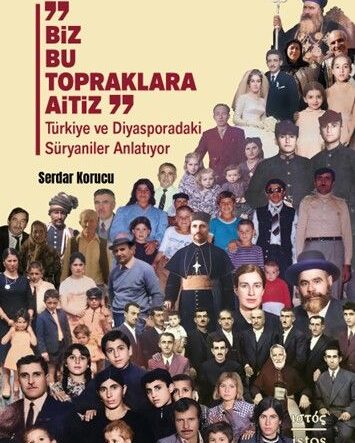
Turkish journalist Serdar Korucu has published a book that traces the Assyrian people’s century-long journey—from the Seyfo of 1915, through the unsolved murders of the 1990s, to today’s cautious dreams of return. Through 38 testimonies from Assyrians in Turkey and the diaspora, a shared sentiment emerges: we belong here.
The book is titled Biz Bu Topraklara Aitiz in Turkish—“We Belong to These Lands”—and is published by İstos Yayın in Istanbul. The title is taken from an earlier TV interview with the Patriarch of Antioch and head of the Syrian Orthodox Church, Moran Mor Ignatius Afrem II, who is reported to have said: “No one wants to leave their home; we belong here.” The sentiment accompanied Korucu into the book project.
A journalist delving into the history of minorities
Serdar Korucu, an editor at CNN Türk, has over the years published a series of books about the groups that official Turkish historiography tends to marginalize—Greeks, Armenians, and Jews. Now it is the Assyrians’ turn, with the book “We Belong Here.”
Voices from a People on the Move
Korucu has not limited himself to Assyrians in Turkey—he has followed them into the diaspora and interviewed Assyrians in several countries where they now reside.
Among the voices are Patriarch Ignatius Afrem II, several metropolitans, and Erol Dora—the first Assyrian in the Parliament of the Republic of Turkey since the days of the Ottoman Parliament. But it is not the famous names that carry the book. It is the others.
A Memory That Won’t Let Go
In the book,Yusuf Aydın recounts how his father was killed in 1993 when the vehicle he was traveling in toward Midyat struck a landmine. It is one of many accounts of the unsolved murders of the 1990s. For many families in Tur Abdin, it was not the Seyfo that prompted the decision to leave. It was decades later, when fathers and villagers began to disappear without any trial following.
“The Assyrian Quarter Without Assyrians”
Korucu also highlights a contemporary paradox. The tourism economy in Mardin and Midyat is largely based on Assyrian heritage: “Assyrian wine,” “Assyrian silver” (telkari), Assyrian architecture, Assyrian alleys. But the people themselves are gone. Yuhanna Aktaş puts it bluntly: we call it the Assyrian Quarter, but there are no Assyrians left in it. Ayten Ekinci adds—most products sold today under the name “Syrian/Assyrian” in Mardin do not even exist in the local culinary tradition. The heritage becomes a brand. But a brand without an owner.
“Not an end, but a beginning”
What makes the book interesting is not that it confirms what Assyrians already know. It is that it does so through a Turkish publisher, by a Turkish journalist, in Turkish—and that it lets 38 Assyrians speak without any filter.
In an interview with Agos, Korucu himself says that the 38 voices are not enough. One of his interviewees, Simon Poli, is reported to have said that every family has five stories to tell, not just one. Korucu agrees. The book, he says, is not an endpoint but a beginning. He hopes that more similar works will be produced before the witnesses disappear along with their stories.
In addition to Assyria Post’s coverage, Assyria TV has conducted an in-depth interview with Korucu about the book project. The book is now available in Turkish bookstores, published by İstos Yayın. It can be purchased here, among other places .

