
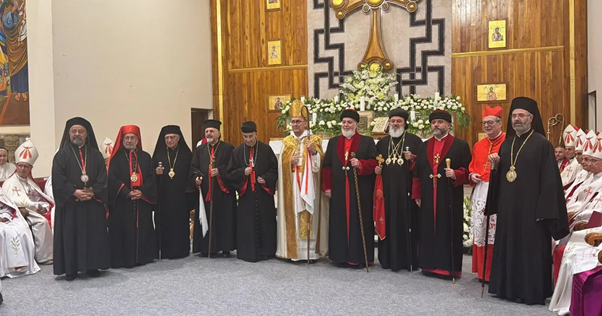
Baghdad 2026 – A historic gathering where the patriarchs of the six Syrian Churches came together for the first time for the inauguration of Patriarch Mar Paul III Nona. Those present included Mor Ignatius Joseph III Younan (Syrian Catholic Church), Mor Bechara Boutros Rahi (Syrian Maronite Catholic Church), Mar Paul III Nona (Chaldean Catholic Church), Mar Awa III (Assyrian Church of the East), Mor Ignatius Aphrem II (Syrian Orthodox Church), and Mar Gewargis III Younan (Church of the East).
While AI and the tech giants are driving the world forward at full speed, the Church, as it has done so many times before, chooses to pause, look back, and offer perspective. This is clearly demonstrated in Pope Leo XIV’s encyclical *Magnifica Humanitas*, which emphasizes that AI must not be allowed to redefine the human dignity that has already been given to us by God. Close by, in the East, we hear long-awaited words from the new patriarch of the Chaldean Catholic Church, Mar Paul III Nona.
In one of his first speeches, Pope Paul III mentions how the Chaldean Church looks back to its roots and finds communion with the Churches of the East, particularly the Assyrian Church of the East and the Ancient Church of the East. This is nothing new to the well-informed; for we share not only the same suffering, tradition, history, and liturgy, but also a common theology regarding the nature of Jesus. This Christology, which has long divided us—both as a people and as a church—has, since 1994, following the meeting between the then-Pope John Paul II and Patriarch Mar Dinkha IV, been largely overcome through a joint Christological declaration. A bridge was built between the Catholic Church and the Assyrian Church of the East. This bridge is being restored and further built upon today by the three current heads: Pope Leo XIV, Mar Awa III, and Mar Paulus III.
“Whatever our Christological differences may have been,” reads a passage from the 1994 Declaration, “we find ourselves united today in the confession of the same faith in the Son of God, who became man so that we might become children of God by his grace.”
John Paul II and Mar Dinkha IV, 1994.
The implication of this consensus is that the accusation and the term “Nestorians” can no longer be used to denigrate the Assyrian Church of the East without simultaneously revealing the user’s ignorance on the matter. Consequently, such an accusation should be met with a justified polemical response from approximately 1.2 billion Catholics, who would then be accused of the same thing.
It would be wrong to downplay the importance of the issues that divide us; that is not my goal. What I want, instead, is for us to reflect on what the primary issues are and what is secondary. The dialogues must not end, but the divisions should. I do not want us to erase our differences; rather, I want us to view them for what they are. In some cases, they are enriching; in others, they are an opportunity for learning.
“The division of the Christian church is a grave error, a blasphemy against the Holy Spirit, and a disregard for the existence of Christ, who promised: ‘… the gates of hell shall not prevail against it.’ (Matthew 16:18)”
His Holiness Ignatius Zakka I Iwas, Patriarch of Antioch, 1995
Can we, for example, expect a struggle to reclaim the churches in Hakkari that belong to the Assyrian Church of the East—which, under Turkish rule, have been slandered with the term “Nestorians” and denied their rights? I hope so, since Mar Paul III, later in his speech, mentions how he looks forward in the same way he looks back, in communion. This is, of course, one of many issues that should be addressed on multiple fronts—politically, humanitarily, and ecclesiastically.
As a stateless people, we often need to turn to the church for clear leadership and unity. Historically, this has at times proven to be a pitfall, but today I view it with hope. That is why these overtures from the Eastern churches are a matter of survival for us as a nation. We see that distancing ourselves from the church in the West has been a failed project; let us not invest our time and energy in the same mistake.
So what is the lesson here? It is clear that our differences will be used against us, so let us not arm our enemies with our actions. To me, the above serves as inspiration; despite 1,500 years of disagreement, with the right attitude, courage, and hard work, we can find common ground. Furthermore, I hope that in an era of polarization, fueled by social media, we can draw inspiration from the church; pause and reflect.
This places high demands on our churches, organizations, and political parties—but above all on us as individuals—to constantly remind one another that our differences lie on the surface, while what we share runs deep. I am now following the example of Pope Paul III and looking ahead. I do so with faith, hope, and love, and the greatest of these is love. (1 Corinthians 13:13)

