
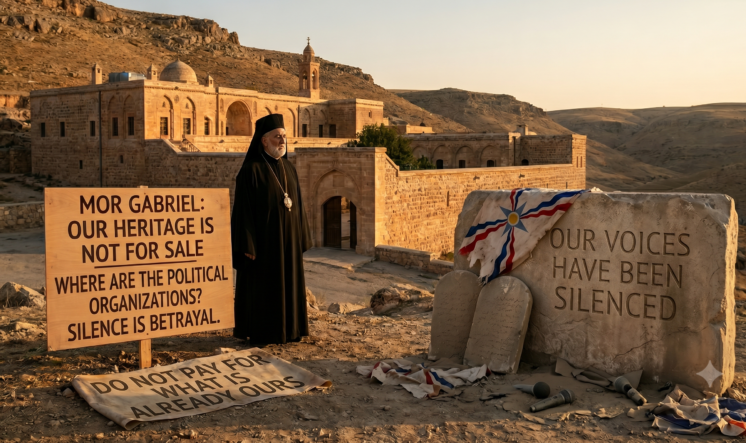
The recent appeal by the Monastery of Mor Gabriel to the Assyrian diaspora for financial contributions to purchase land surrounding the monastery should have sparked a wave of reactions. Not only because Mor Gabriel is one of the most important religious and historical centers of our people, but above all because the issue raises fundamental questions about justice, property rights, and political representation.
Yet the silence is deafening.
Where are the political organizations that claim to represent the interests of the Assyrian community? Where are the statements, the protests, the campaigns, and the international advocacy efforts? Organizations such as ADO and Doronoye seem to be absent at a time when their voices should be heard the loudest.
This silence is not an isolated incident. It is evidence of a deeper problem.
Do Our Political Organizations Still Exist?
On paper, yes. In practice, less and less so. A political organization does not derive its legitimacy from its history, its flag, or its name. It proves its relevance by defending the interests of the people it claims to represent. When fundamental rights are violated, when historical heritage comes under pressure, and when injustice occurs, it becomes clear whether an organization is still truly functioning. The situation surrounding Mor Gabriel is one such moment. The absence of a strong political response is telling. It confirms what many within the community have felt for years: our political organizations have become shadows of what they once were. Structures that continue to exist formally, but whose social influence and mobilizing power have largely disappeared. Those who remain silent in the face of injustice ultimately choose passivity. And passivity never benefits the oppressed.
Should We Pay for What Is Already Ours?
My answer is clear: no. Not just no, but a thousand times no. To understand the current situation, we must examine the origins of the problem. Until the beginning of the 21st century, large parts of Tur Abdin were not officially registered in a comprehensive land registry. When the Turkish state began registering land ownership in the early years of this century, numerous disputes arose over property rights. According to many residents and observers, substantial tracts of land that had historically belonged to Assyrian families, villages, and religious institutions were registered as state property. The consequences of those decisions are still felt today. The land disputes involving Mor Gabriel must be viewed within that context. This is not a new conflict. The issue has persisted for many years and has become internationally known as an example of the complex property disputes faced by religious minorities in Turkey. That is precisely why the current appeal feels so troubling.
From Resistance to Purchase
For years, Mor Gabriel resisted the idea that the monastery should pay for land that, according to its historical claim, already belonged to the monastery. This was a principled and understandable stance. After all, what does it mean to pay for something that is already yours? It implicitly means accepting that your property rights are insufficient. It means rewarding those who challenge your ownership. And it means shifting the financial burden onto the very community that has already suffered from the dispute for decades.
A Dangerous Precedent
The biggest problem may not even be the amount of money that needs to be raised. The biggest problem is the principle itself. If we pay today for land that we believe historically belongs to us, what message are we sending for the future? That historical rights are negotiable? That ownership ultimately depends on financial resources? That injustice can be resolved by forcing the injured party to foot the bill? That is a dangerous precedent. Supporting Mor Gabriel should never be confused with endorsing this course of action. The monastery deserves protection, solidarity, and support. But that does not automatically mean that the community should accept every proposed solution without criticism.
Time for Political Courage
Ultimately, the Mor Gabriel issue is about far more than a piece of land. It is about whether we, as a community, are still capable of defending our collective interests. It is about the role of political organizations that have barely made their voices heard. And it is about the willingness to take principled positions when fundamental rights are at stake. The silence of our political organizations may therefore be even more alarming than the conflict itself. Because a community without political representation risks losing its voice. And a people who lose their voice ultimately lose far more than land.

